
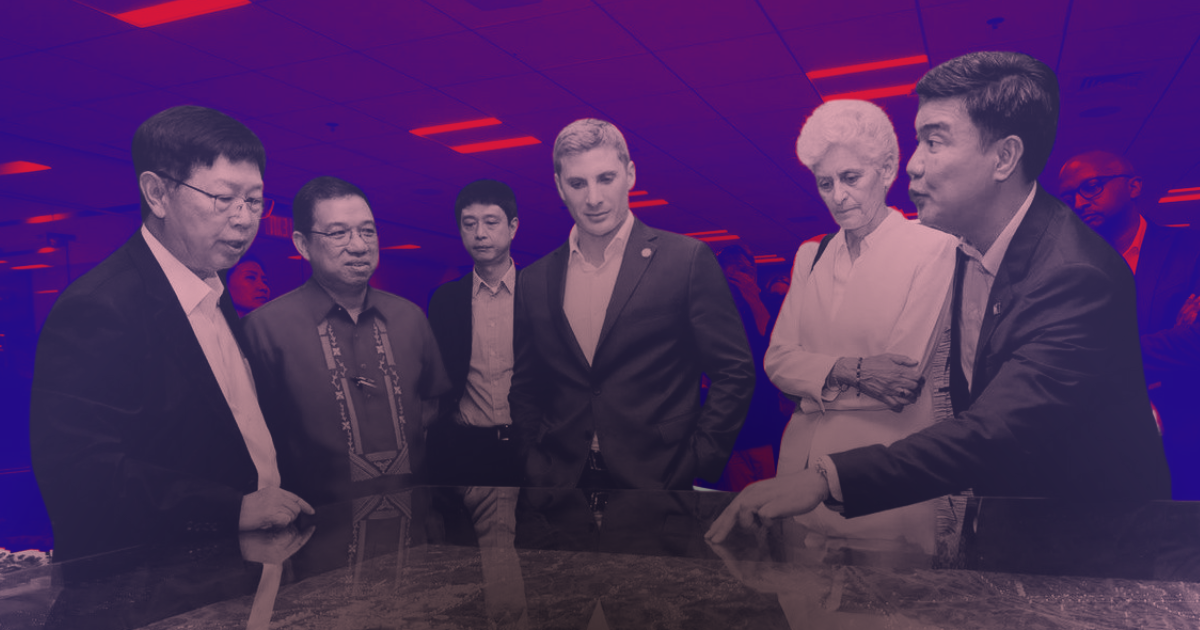
Hand in hand with the US and other billion-dollar companies, President Ferdinand Marcos, Jr. carries on his parents’ legacy of erecting spectacular infrastructure to impose, impress, and conceal. For an administration that prides itself on AI-enabled omnipotence, Marcos, Jr. falls short of delivering crucial information about Pax Silica’s eye on the 1620-hectare AI industrial hub in New Clark City (NCC), save for the claim that the development would elevate the Philippines in the AI industry. Whose welfare is discussed? Who are consulted apart from global investors? How does the hub position the Philippines in the ongoing tech war between China and the US? What are the human and environmental impacts of the hub on nearby indigenous peoples and the still contested NCC grounds?
Pax Silica, the flagship initiative of the United States to secure AI infrastructure and semiconductor supply chains, is an international coalition countering China’s near-monopoly on rare earth elements and critical minerals. On April 16, 2026, the Philippines became its 13th signatory, with the country eyed for its significant reserves of critical minerals and its role as a critical production hub in the global supply chain.
Progressive groups like Bagong Alyansang Makabayan (Bayan) and Kalikasan People’s Network for the Environment have since called for transparency, wary of the massive sellout of the country’s resources and the future hub’s possible involvement in war production. Anybody dismissing these concerns should acknowledge that Pax Silica is profit-oriented, what the head of its launch US Under Secretary of State Jacob S. Helberg would say is “fundamentally a capitalist project (this might be foreign to you) that’s a lot more about partnerships between private companies than it is about government programs” under his own account on X. Indeed, covered under the business section of multiple newspapers, his visit last May 18 to inspect NCC was reported to stress concerns for the protection of investors spending “billions of dollars” in the Luzon Economic Corridor.
“Every single company who’s here is interested in potentially being a part of this historic effort. We have over a dozen companies that are here with us, several of them are over a billion-dollar companies. We need to figure out and finalize the sectors that will get prioritized around an anchor tenant and based on that, we will build out an ecosystem of companies that contribute to the master tenant activities.” —Jacob Helberg
Joshua Bingcang, president and chief executive of the Bases Conversion and Development Authority (BCDA), would later clarify that they rejected the US’s request for diplomatic immunity, stressing that the “transaction here” would be treated as “a regular business development contract.” He also said in an earlier statement that the AI hub would translate to job creation and place local enterprises on the global map.
The US Embassy, for their part, said that the hub designated as an Economic Security Zone (ESZ) would be managed by “joint governance.” They did not bother explaining how much US control and access over Filipino labor and resources this allowed.
The Terrible Opaqueness of Search Engines
For all his flexing of US superiority (“a fact I’m sure deeply irritates you”—still from the same aforementioned X post), all Helberg had in response to critics recognizing US imperialist expansion in the Pax Silica coalition was a dismissive “[that’s] ignorant loser mentality,” inadvertently (perhaps) playing the role of a classic imperialist denying its colonies intelligence.
Of course there would be no mention of the US war of aggression on Iran putting pressure on the semiconductor supply chain. Chip companies now turn to diversifying the supply chain in Southeast Asia and South Asia to deal with the rising costs of semiconductors, hence Pax Silica. Semiconductors, especially advanced chips, are critical to modern weaponry as they drive AI technology. The US military has, in fact, confirmed their use of advanced AI tools in their war against Iran, with semiconductors computing vast amounts of data in seconds and AI making smarter decisions to run drones, conduct surveillance, and spot targets. This power has also proven useful to the US in their attacks on Venezuela and Palestine. It is no coincidence that Japan, South Korea, Israel, Australia, and more apart from the US are invested in semiconductors and AI as they are crucial to national defense.
Clearly, the Philippines is being used as a military base of the US in its tech war against China. This is thus where concerns over PH’s location in war production come in, as it would be strategic to attack military bases in the event the US wages war against China. This collaboration of nations, PH included, with US and Israel for the AI hub in NCC is not just another regular business contract.
And then in this age of compound climate events, we also cannot not worry about the environmental implications of housing the first AI-native hub. Being AI-native means that this hub is not merely appending or integrating AI; it is run by AI from the ground up, operating with AI as its core foundation. Intrinsically dependent on AI data centers but with infrastructure development yet to unroll in 2028, the hub would rely on the country’s hyperscale and AI-ready facilities.
To date, there is one AI-ready hyperscale data center in the Philippines. Launched April 2025 in Sta. Rosa, Laguna, VITRO Data Center was intended “to attract the world’s largest technology companies and showcase the country’s regional competitiveness in the digital space.” Marcos, Jr. who led the launch appealed to investors—“the Googles, the Amazons, the Facebooks of this world”—to look at Filipinos as “your greatest asset!”
Search results about VITRO would yield a lot about its being the country’s first AI-ready data center and not so much about its potential impacts on the environment or nearby residents, at least. This is an overwhelming lack of information at a time when there is a growing opposition to data centers from local communities worldwide, mostly in the rural US areas where tech giants like Amazon (AWS), Google, Microsoft, and Meta aggressively develop and expand their data centers.
Many of the complaints revolve around lost access to basic needs like clean water and shelter owing to data centers’ rapacious consumption of space and fresh water. Such is the case of the browned local water supply of Morgan County, Georgia since the construction of a Meta data center in the community. Even air is under threat as heat islands—spaces that emanate higher temperatures than the surrounding area—are generated by the infrastructure. Add to these the raised concerns over respiratory issues, noise pollution, and surges in water and electric bills. These impacts of data centers impinge on human rights because the decent living conditions of local communities become secondary to the demands of the global market.
The selection of data center sites is not a neutral, innocent choice. In the US, where Donald Trump is aggressively fast-tracking the expansion of AI data centers to keep an edge over China, the choice of Bessemer, Alabama to house a 1600-acre hyperscale data center is a designation of lower-income and predominantly Black population as the more expendable bodies. This, despite the community’s vocal opposition to the project over health and environmental concerns. Marcos, Jr. mirrors Trump when he welcomes Pax Silica to expand the US territory on already contested ancestral lands.
The Clarity of Life Off-Grid
The beginnings of NCC a decade ago were met with interrogations from people’s movements concerned about its profit–oriented development. The construction of the metropolis, founded on the displacement of indigenous communities and the extraction of local resources, rode on the promotion that NCC was to be “the most inclusive and sustainable city in the country.” It promised not only jobs but also benefits for the displaced IPs and farmers.
A quick internet search today of the keywords “new clark city ancestral domain displacement” would support this with an unsolicited AI Overview that lists, for its first point in emphatic boldface, the “No Ancestral Domain” stance. This is followed immediately by actions taken by the government: financial assistance, relocation, and livelihood support. Nowhere in this unprompted defense, this curated “democratized access” to information, are the counter-narratives of communities directly affected by the smart city project.
Last year, I went to Capas, Tarlac to volunteer for Liwanag at Dunong (LD), a non-government organization committed to teaching the adults of the Aeta Mag-Antsi community to read and write.
The organizers shared with us accounts of the land’s development as soon as we reached Bamban in a rented van. There, Ms. Ning gestured towards the ghost town that the POGO hub, the Baofu compound connected to Alice Guo, had become. The long stretch of land we traveled evidently benefited multinational corporations, seen in the line of fastfood chains and other private enterprises on the side of the road, but it did not do so much for the community. Basic services, especially health services, remained remote. No hospitals were built. Tricycle terminals were limited to cemented grounds, what I would later learn was the community’s territorial marker for the world of the “unat.” Because no terminals were built nearby Sitio Gayaman, volunteers would commute out of the community on the sitio fathers’ kolong-kolong. This was until volunteers grew in number and have since then been able to rent a van.
We passed by several garbage trucks on their way to grow a sacrilegious heap across the Kalangitan Prayer Mountain. This sacred ground received no deference from businessmen who wanted to golf their stress away, so they razed the mountain flat and paid for their sins with job offers for natives, minus the employee benefits. The golfers have yet to come up with a penance for razing too near a local cemetery and worrying the living about where to place their dead.
Further in, we passed by a long wall toothed on the upper edges to mimic a castle: the Kalangitan Landfill, just right across the prayer golf course. Canada used to dump their toxic waste in that battlement, and so managed to smear people sick despite its distance from the country. The waste dispute with Canada has since been resolved, but locals cowered for new olfactory assailants. The burning of garbage from the landfill stank so terribly headaches became common. For all the new roads in Tarlac, the sick could not find their way to accessible treatment.
It was around 8 a.m., a three-hour trip overall, when we arrived at Sitio Gayaman. Only DITO sim cards worked there so we had no signal at all. We learned that the idea for teaching the adults came from the adults themselves, who expressed they wanted to learn to read and write like their children. Their reasons ranged from being able to fill out basic forms for their children in school, to being able to resist middlemen who shortchanged them on rice and officials who deceived them into affixing their thumbprint on “census” documents, only for them to later learn that they had just sold their land. One of the mothers asked, “Madam,” what the community called teachers, “Hindi ba kami mga tao?”
Tatay Nelson, chieftain of the Mag-Antsi tribe, welcomed our courtesy call and shared the story of their forced resettlement in Tarlac owing to the 1991 Mt. Pinatubo eruption. He shared their initial struggle with language, their eventual victory over it, and their present aspirations to learn how to read and write. Tatay Nelson himself wanted to be a lawyer so he could defend the rights of Aeta families.
Beyond the houses, in the horizon where lamp posts stood tall with trees and indicated development plans for NCC, new roads licked the earth. Those were for trucks, not for the dwellers. “Ang lupa ay buhay,” the elders kept saying. On some days they roamed farther than usual looking for un-cemented land to till. At the very least, they hoped the government would compensate them in case their homes were run over. According to the written word, they had rights but no titles. To the community, title was knowledge of the land.
What else now lies for our IPs when AI ecosystems are hungry for not just land?
Versus (AI)difice Complex: Ancestral Intelligence
As a humanities teacher, I cannot unsee the potent strategy in the recent reframing of the GE curriculum so that our young are reared to be natives of this invented reality, where “AI-driven,” “future-ready,” “regionally competitive,” “advanced,” and “world-class” are the growing workforce’s regurgitated phrases muffling questions that dare drag the conversation, all just to pause and consider, to slow down and to feel and to feel for. To feel with. To care.
Glaring is the structured attack on history, art, and ethics at the high school and collegiate levels, all the while state institutions and companies alike—devoured by “AI is here to stay”—are now rushing to offload mental and emotional labor to GenAI. I bring this up because if we are to counter AI-intensified capitalism, our youth should be with us. It is a great irresponsibility to push AI integration in schools without opening opportunities for learners to discuss its costs. There is already an abundance of promotional material for the future with AI, and not so much about the contexts of their production. This orientation will significantly contribute to a growing population whose reflex to AI criticisms is to parrot “outdated,” “traditional,” and “counterproductive,” as if life lived in increasing speed, resistant to examination, is the most ideal way of life we can imagine.
Alternative futures are reared young. If the powers-that-be are moving fast and structured with their AI invasions, then we, too, should be strategic, building an infrastructure of other possible-worlds beginning in what we teach our young.
The Ubuntu philosophy, famously translated, “I am because we are,” is often positioned as a counter to individualist and market-driven ethics. This is not a foreign practice among our indigenous peoples. In Lumad culture, one did not possess joy but shared it. No learner in Sitio Gayaman wanted to be a legendary icon, what the media liked to frame as a success story of a certain graduate from a vulnerable community. Education had to be for all.
To the Mag-Antsi tribe, sustainability depended on communal sharing. Hunting sustained them because the catch of one was not relished alone but shared freely with the community. Theirs is a culture of collective care and mutual responsibility that the Philippine government, the US, and billionaires are clearly estranged from. I mean, Helberg was at least right about capitalism being foreign to some peoples. In pursuing Pax Silica’s AI hub, over whose welfare are the investors taking responsibility? Is the projected development mutually beneficial for the PH and the US? Is it inclusive in that no local community shall suffer for the benefit of the bigger population? Who owns the data upon which they are founding their generated future of the world?
There is nothing transparent about this AIdifice Complex. If it should be based on any vision, it should be on a future that caters to the local, rooted in nationalistic, scientific, and mass-oriented data.
If development comes at the expense of indigenous and farming communities, then that development is not smart and neither is it future-ready.