
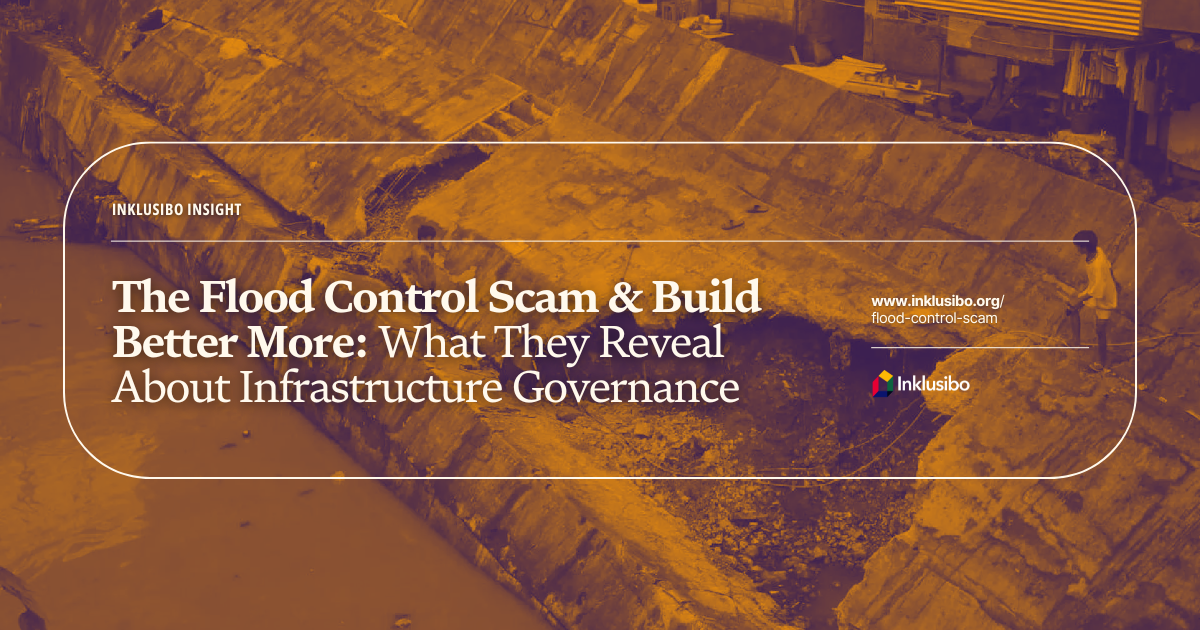
The Department of Public Works and Highways (DPWH) gets one of the largest slices of the national budget—a staggering P880 billion for 2026 alone, wherein P251 billion, or almost 30%, is allocated to flood control projects.
But where does all that money actually go? A closer look at the plans reveals a disturbing pattern that benefits the powerful few at the expense of the many.
Flood Control as a Case Study in Misgovernance
Flood control allocations have long been vulnerable to misuse. Projects are notorious for overpricing, “ghost” works, and padded variation orders. The DPWH’s own budget rules even allow fixed deductions—3.5% for the central office, 2.5% for regional offices, and 2% for district offices—for “administrative expenses.” While officially justified as overhead, these provisions institutionalize opportunities for corruption.
In the past few years, the result has been predictable, evident in the common sight of communities suffering from flooding despite billions in spending. For the urban and rural poor, this means recurring loss of livelihoods, repeated displacements, and no genuine relief from natural disasters and the undeniable effects of the climate crisis.
Flood Control as a Site of Capital Accumulation
The DPWH’s 2026 budget architecture positions flood control as a major conduit for corruption and political brokerage, while embedding the program within foreign-assisted financing streams that reproduce imperialist leverage over Philippine infrastructure priorities. The urban and rural poor bear the immediate costs of recurrent flooding and disruptive, frequently delayed projects, yet are structurally excluded from planning and oversight.
Several features in the DPWH budget concentrate discretion (e.g., sizable “Project Related Expenses” skim percentages, Public-Private Partnership support funds) and expand external dependence (e.g., large loan-driven project lists), creating layered opportunities for corruption by local bureaucrats and policy capture by foreign lenders (IBRD/World Bank, ADB, JICA, etc.).
Foreign-Assisted Projects and the Imperialist Grip on Infrastructure
The DPWH’s infrastructure program is heavily interwoven with foreign-assisted projects financed by multilateral development banks (MDBs) such as the World Bank (through its lending arm, the International Bank for Reconstruction and Development or IBRD), Asian Development Bank (ADB), and Japan International Cooperation Agency (JICA).
These financing arrangements reveal how US imperialism and allied powers exert control over Philippine development priorities, not only through direct bilateral agreements but also via MDB loan conditionalities and technical assistance requirements.
Expressways, transport corridors, and even flood control projects are packaged alongside “resilience” or “development” agendas but are structurally subordinated to repayment imperatives and bankable project designs that serve foreign capital. This constrains domestic sovereignty and ensures that Philippine state resources, including taxes extracted from the urban and rural poor, are funneled into debt servicing and consultancy fees rather than comprehensive flood protection for vulnerable communities.
The Poor and Flood Vulnerability
The urban and rural poor are always at the frontline of flood disasters, but are systematically excluded from DPWH planning and budgeting. In the agency’s performance tables, the measure of flood management success is expressed as “percent decrease of areas prone to flooding,” yet current and target values are marked “N/A,” reflecting the absence of concrete, people-centered benchmarks.
Instead, the program emphasizes physical outputs (number of structures built, kilometers of drainage constructed) and loan-driven mega-projects that do not account for localized impacts on communities. Right-of-way (ROW) provisions in the budget empower DPWH to clear areas for projects, which historically result in demolitions and evictions of poor households without adequate resettlement or livelihood restoration.
This embodies a dual violence against the ordinary Filipino: flood control projects are structured for contractor profits, while the poor are displaced, dispossessed, and left vulnerable to recurring floods.
Marcos Jr.’s Political Responsibility for Corruption and Foreign Dependence
Ferdinand Marcos Jr., as chief executive, holds direct political accountability for the corruption-prone and foreign-driven infrastructure framework institutionalized in the DPWH’s flood management program. While most implementations are operationalized at the agency level, they are politically legitimized at the highest level of governance. Marcos Jr. has repeatedly promoted “Build Better More” as his flagship program, signaling his administration’s commitment to sustaining these mechanisms.
From this perspective, this accountability is twofold: (1) domestic responsibility, for endorsing budget designs that enable corruption, displacement of poor communities, and lack of measurable flood resilience targets; and (2) imperialist complicity, for deepening dependence on US-dominated multilateral finance (World Bank, ADB) and allied powers (JICA) that shape infrastructure priorities.
From “Isolated” Scams to Systemic Violence
The flood control scam is not an isolated scandal. It is the face of the entire Build Better More program. The same mechanisms of corruption, private profit guarantees, and foreign dependence that define flood projects also define expressways and bridges.
This means that exposing the flood scam is about more than anti-corruption. It is about revealing the structural exploitation embedded in the Philippines.
Real development requires a complete reorientation: away from bureaucrat-capitalism and imperialist dictates, and toward people-centered infrastructure anchored on national industrial policies that protect livelihoods, build genuine resilience, and uphold sovereignty. However, such reorientation will require more than “independent investigations” or “Congress hearings”. It would need sustained collective actions from the people. Historically speaking, the means to achieve radical change in society is determined by mass movements. Only then can infrastructure truly serve the Filipino people.